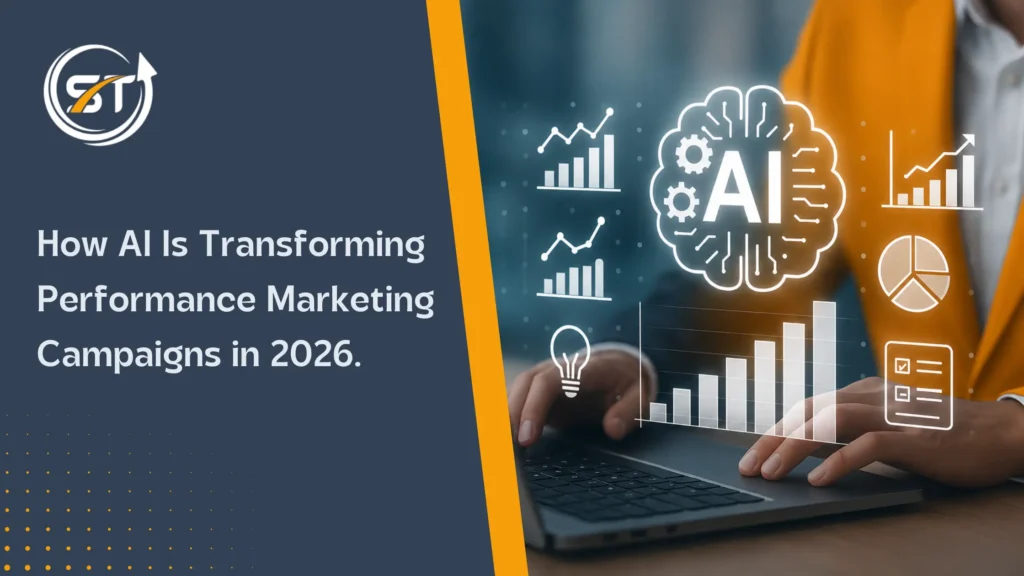
A few years ago, “AI-powered” was a phrase agencies used to stand out. In 2026, it’s just how performance marketing works. If you are still managing bids manually or creating audiences from a spreadsheet, you are likely missing opportunities to get better results from your budget.
This is not just a trend. Platforms such as Google, Meta, and LinkedIn have rebuilt their ad systems around machine learning, to improve ad performance. The marketers getting the best results are the ones who know how to adapt to this shift.
If you are new to performance marketing, it’s worth starting with the basics. Our benefits of performance marketing guide explains how the model focuses on paying for real results rather than ad visibility.
In this article, we will look at what’s changing in performance marketing campaigns this year and what those changes mean for your strategy, budget and reporting.
Media Buying Doesn’t Have to Be Manual Anymore
For a long time, performance marketing meant checking dashboards every morning, adjusting bids, and pausing campaigns that weren’t working well. That kind of hands-on monitoring is becoming less necessary.
Platforms like Google Performance Max and Meta Advantage+ can automatically adjust bids and optimize, and audience targeting in real time. While advertisers still set campaign budgets manually, the platforms use historical performance, campaign trends, auction signals, and machine learning algorithms to determine how that budget is utilized across available opportunities. This allows campaigns to respond much faster than someone manually reviewing and adjusting performance once a day. And if enabled, AI can also help with image and video enhancements to improve creative performance.
Predictive tools are more comprehensive. Artificial intelligence can now predict how valuable a customer might be by the few interactions they have today. This way campaigns can be targeted to get the right customers, not just the cheapest clicks. Multi-touch attribution gives you more context by letting you know which channels actually led to a conversion.
This is where AI performance management becomes a useful planning tool, not just something running in the background. Instead of just reviewing what happened last month, you get a clearer picture of where things are headed while the campaign is live.
AI Marketing Automation Is Bringing the Whole Funnel Together
The marketing funnel has always followed the same basic stages: awareness (TOF), consideration (MOF), conversion (BOF) and post-purchase engagement. In 2026, it’s not the funnel, but rather how AI helps marketers do each stage better with predictive insights, automation and continuous optimization.
Example: How AI Enhances a Traditional Marketing Funnel
Think about a brand selling running shoes. The marketing funnel (TOF, awareness; MOF, consideration; BOF, conversion; retention) has not changed in years. What AI changes is the way that each stage is executed and optimized.
| Traditional Funnel | AI-Enhanced Funnel |
| Top of the Funnel (TOF): AwarenessMarketers target sports enthusiasts using demographics, interests, keywords, or broad audience segments. | Top of the Funnel (TOF): AwarenessAI analyzes thousands of signals, including browsing behavior, search intent, previous purchases, content engagement, and historical campaign data, to identify people who are most likely to be interested in running shoes. For example, it may prioritize users who recently searched for marathons, follow fitness creators, read shoe reviews, or frequently purchase sports gear online. |
| Middle of the Funnel (MOF): ConsiderationWebsite visitors are retargeted with standard product ads or the same messaging across all users. | Middle of the Funnel (MOF): ConsiderationAI evaluates how users interact with the brand and predicts who is moving closer to making a purchase. Based on these insights, it can automatically serve the most relevant creative, product recommendations, or messaging to different audience segments instead of showing everyone the same ad. |
| Bottom of the Funnel (BOF): ConversionCart abandoners receive a discount, while marketers manually manage bidding strategies and campaign optimization. | Bottom of the Funnel (BOF): ConversionAI identifies users with the highest likelihood of converting and automatically adjusts bids, selects the best-performing creative, optimizes ad delivery, and determines the best time to show the ad based on real-time auction signals and user behavior. |
After Purchase (Retention)
Traditionally, a customer would get the same set of post-purchase emails. AI allows for the customization of these follow-up messages to customer actions.
For instance, someone who has bought running shoes might be offered running socks or fitness accessories, while a different customer who hasn’t used their discount code could be reminded at the time AI has predicted they’ll be most likely to engage.
The Key Difference
The marketing funnel itself hasn’t changed. Awareness, consideration, conversion, and retention have always been fundamental stages of digital marketing. What AI has changed is the execution. AI continually analyzes campaign results, customer behavior and real-time signals and makes smarter decisions at every stage, rather than relying on fixed audience rules, predefined workflows and manual optimizations. This allows marketers to increase relevance, optimize ad spend and provide more personalized customer experiences, at scale.
Traditional vs. AI-Powered Performance Advertising
A simple comparison table shows how things have shifted :
| Aspect | Traditional Performance Marketing | AI-Powered Performance Marketing |
| Bid adjustments | Manual, reviewed daily or weekly | Automated, adjusted continuously in real time |
| Creative testing | One or two variants, weeks to reach significance | Dozens of variants tested in parallel |
| Audience targeting | Fixed demographics and interest segments | Predictive scoring based on likely value |
| Attribution | Last-click, often misleading | Multi-touch, weighted by actual influence |
| Reporting cadence | Weekly or monthly review | Continuous, with alerts on shifts |
Where a Human Touch Still Matters
Even with all this automation, it still helps to have someone keeping an eye on things.
- AI works toward whatever goal you set, so it’s important to double-check that your tracking and KPIs are set up correctly
- Automated creative testing can sometimes favor what performs over what fits your brand, so it’s worth reviewing the results regularly
- Attribution numbers are worth a second look from time to time, just to make sure they align with what you would expect
This is often where performance marketing agencies add real value, not by simply running the AI tools, but by knowing when something needs a closer look.
Getting Started Without Rebuilding Everything
You don’t need to change your entire approach right away. Most teams find it easier to start with one part of the process such as bidding, creative testing, or attribution and introduce AI there first, once their tracking is clean and reliable.
Start small, measure the results, and build from there. When AI doesn’t work well for a team, it’s usually not because they moved too slowly, it’s because automation was turned on before the data was ready.
The Bottom Line
Performance marketing still focuses on the same key metrics, cost per lead, ROAS, and conversion rate. The difference is that AI helps you see results faster and more clearly. It doesn’t replace strategy; it just takes care of the repetitive tasks, giving your team more time to focus on important decisions like positioning, offers, and brand voice.