Key Takeaway
Search Data → Content Insight → SEO Opportunity → Growth
- Understand how social content performs in Google Search.
- Turn search queries into SEO content opportunities.
- Connect social insights with website and business goals.
- Measure leads and conversions, not just visibility.
- Use Search Console data to inform smarter SEO decisions.
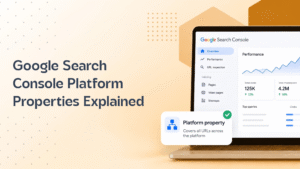
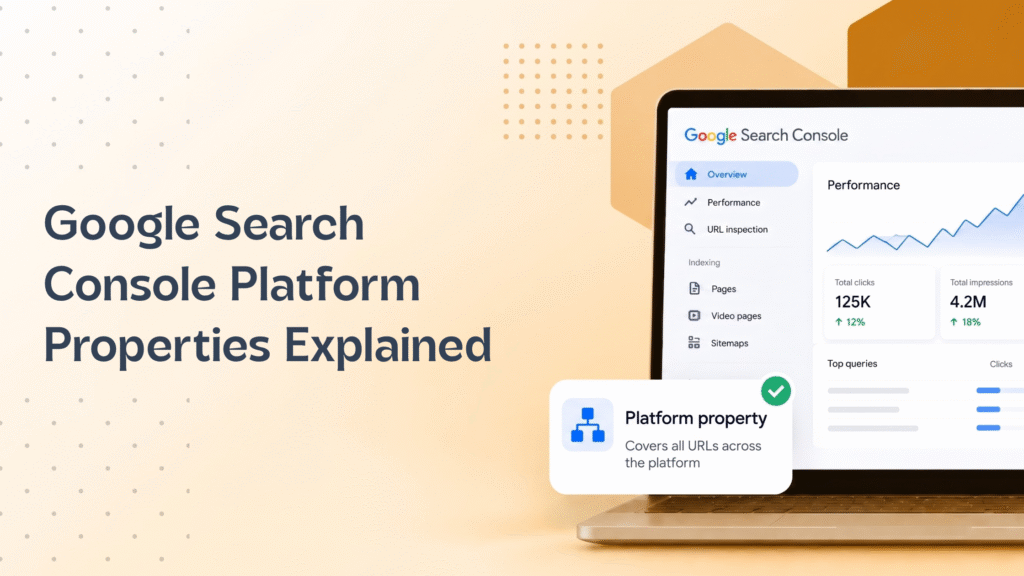
Google Search Console has spent years answering questions such as “How does my website perform in Google Search?” Traditionally, that reporting has focused primarily on websites and their pages. With the introduction of platform properties, Search Console can also provide search performance insights for eligible content published on supported social and video platforms.
This gives brands another way to understand how their social posts and videos appear in Google Search and how users discover and interact with that content.
This reporting now extends to eligible content from Instagram, TikTok, X, and YouTube, helping brands understand how their social posts and videos appear in Google Search and how they perform.
What Google Search Console Platform Properties Are
A platform property is a new type of property in Search Console, separate from a website’s Domain or URL-prefix property. Instead of verifying a domain, you verify your social or Video account.
If connected, a platform property can display Search Console performance data for eligible content from the connected account, including clicks, impressions, CTR and position. Reporting may include Google Search, Discover or Google News where applicable depending on property and Google surface.
Each account on Instagram, TikTok, X, or YouTube is verified and reported on separately. The feature is being rolled out gradually, so availability may vary.
Platform vs. Website Properties
| Aspect | Website Property | Platform Property |
| What it tracks | Pages on a verified domain | Posts/videos on one social or video account |
| Verification/Connection | DNS record, HTML file, or meta tag | Sign-in / ownership check on the account itself |
| Main purpose | Technical SEO and page-level optimization | Search visibility of social/video content |
| Search data reach | Google Search performance for website content | Search, plus Discover and News where applicable |
What the Reports Show and Two Details Worth Knowing
The report shows the same key metrics as website properties: clicks, impressions, CTR (click-through rate), and average position.
There are also two useful features worth knowing about:
Annotations: You can record important changes or events and compare performance before and after them. This makes it easier to identify possible relationships between content changes and search performance, although Search Console cannot prove that a particular change caused the result.
Branded vs. non-branded queries: You can see whether people found your content by searching for your brand or account, or by searching for a topic or asking a question. This matters more here than on a website, since content can attract branded searches that make performance look stronger without necessarily bringing in new audiences.
From Search Query to Business Decision
The real value comes from turning search data into action.
The process is simple: Search query → User intent → Social content → Content opportunity → Website page → Business inquiry
For example, a home renovation brand notices that its Instagram Reel on small bathroom storage is getting clicks for the search term “bathroom storage for small spaces”.
The brand does not have a corresponding page on the website, so it builds one to fulfil the same search intent. It then links the relevant social content to the new page and includes a clear consultation call to action.
This turns a social search insight into a website content opportunity with the potential to support lead generation.
A Concise Workflow
Don’t create and review all the available platforms at once. Focus on one platform. This makes the data easier to understand and use.
- Take a look at the top queries and top posts for a few weeks.
- Segment the searches by topic and intent. Distinguish between branded and non-branded searches.
- Find topics your website doesn’t yet cover that your social content answers.
- Convert these opportunities into useful web pages or improve existing pages as needed.
- Get the process working well then roll the approach out to your other accounts.
- Use analytics and CRM data to see whether those pages lead to clicks, inquiries, or conversions.
Search Console shows search performance, but it does not tell you whether that visibility ultimately resulted in a lead or customer. That requires analytics, conversion tracking, and CRM data.
What the Query Data Actually Reveals
When you look at the data carefully, it can provide useful insight into what your audience is interested in and how they search for it:
- Questions customers are actually asking in their own words
- Topics gaining search visibility before they show up elsewhere in your reporting
- Commercial themes worth covering in more depth on your website
- Content that has already demonstrated search interest and may be worth repurposing
- Gaps between what performs on social and what exists on your website
None of this generates leads automatically. Instead, it shows you where people are already paying attention. Turning that attention into inquiries depends on the content, user experience, and offer you create around those opportunities.
What Platform Properties Don’t Tell You
Platform properties give you useful search performance data, but they don’t replace your other analytics tools. Each tool has a different job:
| Tool | Question it answers |
| Search Console | How are people discovering my content through Google? |
| Social analytics | How are people engaging with my content on the platform? |
| Keyword research | What does the broader search market demand? |
| Analytics | What do visitors do after reaching my website? |
| CRM | Does this activity ultimately contribute to leads/customers? |
One important thing to remember is that connecting a platform property does not improve your Google rankings. It is a measurement and reporting capability, not a ranking factor. Its value comes from giving you additional data that can inform your content and SEO decisions.
Access and Verification Considerations
Because platform properties are connected to the relevant social or video account rather than verified in the same way as a website domain, it is important to know who currently has access to the account and who is responsible for maintaining the connection.
This is especially important when an agency manages a brand’s social media accounts, SEO, or both, and when employees, agencies, or account ownership change over time.
If access or verification is lost, reporting may be affected until the account is reconnected or verified again, depending on how the platform property is managed.
For agencies managing several client brands across multiple platforms, keeping Google Search Console access up to date, checking verification status, and matching platform data with website reporting can easily be overlooked. An ownership and access process can help prevent reporting gaps and ensure that important search data is not lost.
Turning This Into a Growth Opportunity
Brands running multiple social media channels alongside a website often treat them as separate properties, with separate goals for each. Platform property data gives brands a reason to reconsider that approach by looking at social search performance and website content together.
When Search Console data is reviewed alongside website analytics and social performance, it can reveal new content ideas, search opportunities, and gaps between what audiences are searching for and what a brand currently offers on its website.
For agencies and businesses, the opportunity is to turn those insights into a repeatable process: identify search demand, understand user intent, create or improve relevant website content, and then measure whether that content contributes to meaningful business outcomes.
Related Services
Website Design and Development: Build useful pages and conversion-focused experiences around validated content opportunities.
Search Engine Optimization: Turn search data and user intent into a stronger website content strategy.
Search Engine Marketing: Capture additional high-intent search demand through paid search where appropriate.
Social Media Marketing: Create social content that reaches and engages relevant audiences.
FAQs
Do platform properties affect my search rankings?
No. Google presents this data as a measurement tool, not a ranking signal – connecting one doesn’t change how your content ranks.
Do I need a website to use a platform property?
No. You can set up and verify a platform property independently of any website property.
How long does it take for data to appear?
Performance data can take some time to appear after verification.
Can platform property data replace Google Analytics or a keyword research tool?
No. It’s a useful complement – showing search-driven visibility for social content – but it doesn’t track conversions, in-app engagement, or broader keyword demand the way those tools do.