Key Takeaway
Visibility → Trust → Contact → Booked Patient
Turn local search visibility into calls, appointment requests, and a full schedule.
- Show up in Google Maps, organic search, and AI assistants like ChatGPT.
- Pair profile and page optimization with paid local ads to test, scale, and convert.
- Measure calls, bookings, and cost per patient – not just rankings.
- Use reviews, citations, and AI-readable content to build real trust.
- Treat local SEO as a growth system, not a one-time project.
A dental practice can have a professional website, skilled dentists, and great reviews, yet still struggle to show up when local patients search for a dentist online. Often, the problem is not the quality of the practice. It’s about the clarity, accuracy and consistency of its information across Google, its website and AI search platforms.
In 2026, dental SEO services are no longer about using a few keywords or making small website changes. This is a full service strategy that includes building a strong online presence, creating valuable pages on the website, establishing credibility, improving visibility on AI search engines and guiding potential patients from search to booked appointment.
In each step below we have included a simple example and a practical tip to help you understand how to apply it.
Local Search Is Now Part of the Patient’s Decision Journey
In the past, patients usually took several steps to choose a dentist: they searched on Google, visited a website, read reviews, or asked friends for recommendations. Now, the decision often happens much faster:
A patient searches “emergency dentist near me” → scans the Google Map Pack → reads a few recent reviews → calls the practice that looks trustworthy and answers first.
The same pattern can happen with high-intent searches such as
- “dental implants near me,”
- “Invisalign dentist [city],”
- “emergency dentist [city]”
- “dentist open Saturday.”
- “cosmetic dentist near me”
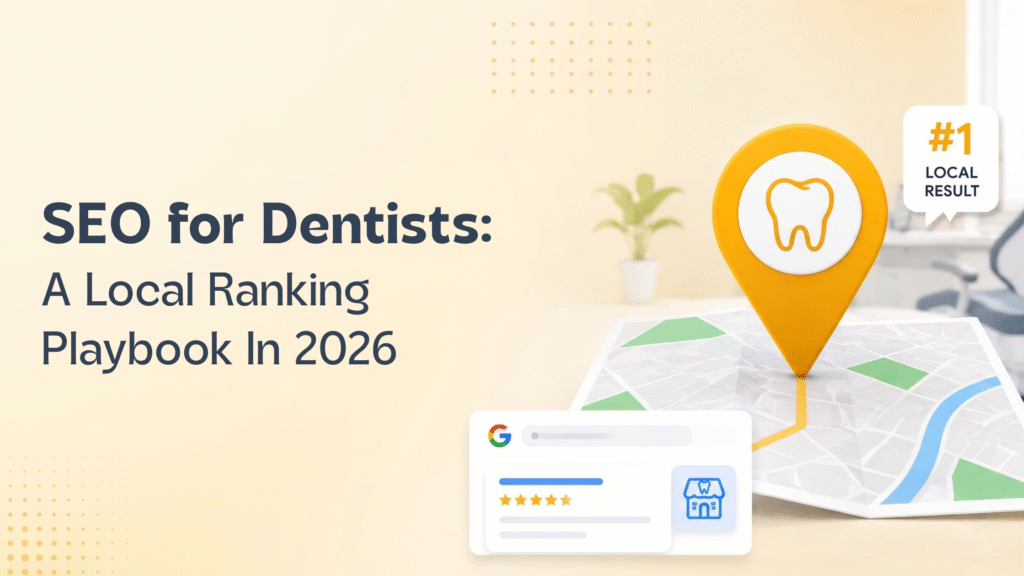
Google is clear about the three main factors that influence which practice appears in the Map Pack:
Relevance – How well a business matches the search
Distance – How close your business is to the person searching
Prominence – How well-known and established the business is
These factors work together, which is why a strong local presence requires more than simply adding a city name to a website.
From Occasional Fixes to a System of Local SEO
Local SEO works better when it’s treated as an ongoing process rather than a series of one-time tasks.
Claiming a Google Business Profile, creating a service page, and then forgetting about it, usually leads to inconsistent results.
A better approach is to treat local SEO as an ongoing system:
Audit the profile → fix service pages → build trust signals → optimize for conversions → track calls and bookings → improve based on the results.
Service Pages Need to Match Patient Intent
A dental practice shouldn’t rely on one generic “Services” page to rank for every treatment or capture every relevant local search. Each important treatment should have dedicated, useful pages that answer the questions patients actually ask – what the treatment is, who it’s for, what to expect, and how to schedule an appointment.
For treatments such as:
| Treatment | Possible search intent |
| Dental implants | “dental implants near me” |
| Invisalign | “Invisalign dentist [city]” |
| Emergency dentistry | “emergency dentist open now” |
| Teeth whitening | “professional teeth whitening [city]” |
| Cosmetic dentistry | “professional teeth whitening [city]” |
A strong dedicated page can also provide a clearer conversion path than a generic services page.
A strong treatment page can include:
- What the treatment is
- Who it may be appropriate for
- Benefits and limitations
- What the process involves
- What patients can expect
- Recovery information where relevant
- Frequently asked questions
- Dentist qualifications or experience
- Financing information where appropriate
- Relevant reviews or testimonials
- Clear appointment options
- Links to related treatments
All these steps work together. This turns local SEO from a list of separate tasks into a measurable patient-acquisition system.
Professional dental SEO services usually manage all these steps together. This may include:
- Profile and citation cleanup
- Improving service and location pages
- Managing reviews
- Optimizing pages for conversions
- Tracking calls and bookings
Instead of treating these as separate tasks, everything works together towards one goal: helping more local patients find your practice and choose it.
Why Profile Optimization and Local Ads Work Better Together
Organic activity – Google Business Profile posts, service pages, and reviews, can reveal which treatments, messages, and offers attract attention. Paid local ads can then be used to test and scale promising opportunities.
The process looks like:
Test an offer in a GBP post → see which one gets the most clicks and calls → put paid search budget behind it → use appropriate remarketing where permitted → convert them into booked appointments.
For example, a practice testing two whitening-offer posts might find that one gets twice as many calls as the other within a week. That’s a strong sign that the better-performing offers are worth boosting through paid ads.
The goal is to use organic and paid data together to identify which messages and offers are most effective.
Pairing profile optimization with search engine marketing allows a practice to invest in proven messages and offers instead of spreading money on something that hasn’t been tested.
From Ranking Position to Patient Metrics
A high Google ranking or more profile views doesn’t always mean you are getting more patients. Focus on metrics that show real results, such as:
| Vanity/Marketing Metric | Patient/Business Metric |
| Ranking position | Qualified calls |
| Profile views | Calls / website actions |
| Website visits | Appointment requests |
| Form submissions | Booked appointments |
| Ad spend | Cost per booked patient |
And one particularly important point:
Cost per lead ≠ cost per patient.
For a dental practice, that’s an important distinction.
A campaign might generate a large number of leads, but not every lead becomes a qualified patient or a booked appointment. Where possible, practices should track the journey from lead to appointment so they can understand which marketing activities are actually producing patients.
Pick the metric that matches your goal, whether you want to fill more appointments overall or get more bookings for a specific high-value treatment.
The key is to track what matters, test different approaches, and keep improving based on the results.
The Data Behind the Shift
According to BrightLocal’s 2026 Local Consumer Review Survey, 97% of consumers read online reviews when researching for local businesses. The survey also reported that consumers now used AI tools for local business recommendations.
This shows that the ranking high on Google Maps is good but not enough. Patients may also turn to AI assistants when looking for a local practice.
That’s why trust signals, consistent business information, and clear, quotable content are becoming increasingly important alongside traditional search rankings.
Rather than trying to create content specifically for a particular AI platform, dental practices should focus on making important information accurate, well-structured, easy to understand, and genuinely useful to patients.
What a Good Dental SEO Company Should Deliver
- Strategy based on local search and competitor research, not a generic checklist
- Straight talk about the marketing platforms and techniques that are worth your money
- Real paid campaign management with real targeting and real conversion tracking, not just boost this post
- Service pages conversion optimization, tied to calls and bookings
- Reports based on patients, not just tracking position
Be wary of proposals that promise guaranty #1 rankings. A good dental SEO company should focus on what really matters: more calls, qualified leads, and booked appointments, not just higher rankings.
When to Invest in Dental SEO Services
- There’s no one in-house with enough time to manage your Google Business Profile, reviews, citations, and ongoing local SEO.
- Rankings have stopped improving despite regular effort
- Competitors are dominating the Google Map Pack for your important treatments
- There’s no clear way to tell which calls actually came from search
- Your service pages are outdated, too thin, or missing entirely
If two or more of these problems apply to your practice, it may be worth considering support from a dental seo marketing agency rather than continuing with scattered SEO fixes.
Treat Local SEO as a Growth Asset
A dentist’s local presence is no longer just a listing to keep updated, it plays an important role in how patients decide which practice to call.
Practices that treat local SEO as a measured system-tracking calls, bookings, and cost per patient rather than rankings alone, are better positioned to turn search visibility into real patient growth.
The process is ongoing:
Audit → Optimize → Test → Measure → Improve → Repeat
Ready to Turn Local Visibility Into Booked Patients?
Whether you build this system in-house or bring in outside help, the goal is the same: clear results, honest reporting, and a steady flow of calls and appointments – not the same checklist every month.
If you’d rather have the work handled for you, request a free proposal, and we will help you identify where your practice may be losing potential patients before they even make a call.